Inbox Placement Testing
Measure deliverability by registering seed mailboxes with EmailEngine, sending to them, and reading back where each message landed: the inbox, the spam folder, and for Gmail which category tab.
This page is about where a message ends up. EmailEngine's delivery test (POST /v1/delivery-test/account/{account} and GET /v1/delivery-test/check/{deliveryTest}) checks SPF, DKIM and DMARC on a message you send to a test address. That is covered on Email Authentication Testing.
Overview
An inbox placement test sends a message to a list of seed accounts at the providers you care about and then checks, for each account:
- Did the message arrive in INBOX or in the spam folder?
- For Gmail: which tab? (Primary, Promotions, Social, Updates, Forums)
- How long did delivery take?
The delay between sending and reading back is the part that needs EmailEngine configuration, because by default a change in a spam folder is only noticed on the next poll.
The Challenge
Normal IMAP Behavior
An IMAP connection can watch one folder at a time for real-time updates (IMAP IDLE):
- EmailEngine keeps the primary connection on INBOX, or on "All Mail" for Gmail
- Every other folder is polled periodically
- Gmail's "All Mail" does not include Spam or Trash, so those are polled as well
That is fine for a normal mailbox and too slow for a placement test.
The Solution: Sub-Connections
A sub-connection is an additional IMAP session that EmailEngine opens for one specific folder:
- The sub-connection sits in
IDLEon that folder, so the server pushes changes immediately - When the folder changes, EmailEngine syncs it and fires the usual webhooks
- Sub-connections are opened after the primary connection is up, and a failed sub-connection does not affect the primary one
Sub-connections are an IMAP feature. Gmail API and MS Graph accounts receive change notifications for every folder from the provider and neither need nor support them.
Connection limits: each sub-connection is one more concurrent IMAP session against the account. Google documents a limit of 15 simultaneous IMAP connections per Gmail account, and other providers have limits of their own, so open sub-connections only for the folders the test needs. The rules for which paths EmailEngine accepts as sub-connections, and how to read their state, are on Performance tuning.
Setting Up Inbox Placement Testing
1. Create a Test Account
Register a seed mailbox with EmailEngine and add the spam folder as a sub-connection in the same request:
curl -X POST "https://emailengine.example.com/v1/account" \
  -H "Content-Type: application/json" \
  -H "Authorization: Bearer YOUR_ACCESS_TOKEN" \
  -d '{
    "account": "seed-gmail-1",
    "name": "Delivery Test Account",
    "email": "deliverytest@gmail.com",
    "imap": {
      "host": "imap.gmail.com",
      "port": 993,
      "secure": true,
      "auth": {
        "user": "deliverytest@gmail.com",
        "pass": "app-password-here"
      }
    },
    "smtp": {
      "host": "smtp.gmail.com",
      "port": 465,
      "secure": true,
      "auth": {
        "user": "deliverytest@gmail.com",
        "pass": "app-password-here"
      }
    },
    "subconnections": ["\\Junk"]
  }'
subconnections is an array of folder paths. It can also be set later with PUT /v1/account/{account}.
2. Using Special-Use Flags
Instead of a folder path, use a special-use flag and let EmailEngine resolve it to whatever the server calls that folder:
{
  "subconnections": ["\\Junk"]
}
Special-use flags EmailEngine matches against the folder listing:
\\Junk- the spam folder\\Trash- deleted items\\Sent- sent messages\\Drafts- drafts
3. Using Folder Paths
Or name the folder exactly as the server lists it:
{
  "subconnections": ["[Gmail]/Spam"]
}
Gmail folder names:
[Gmail]/Spam- spam folder[Gmail]/Trash- trash[Gmail]/All Mail- the folder the primary connection already watches
Outlook.com and Exchange folder names:
Junk Email- spam folderDeleted Items- trash
On a Gmail account only \\Trash and \\Junk (or their paths) are accepted, because "All Mail" already covers every other folder. Requesting [Gmail]/Sent Mail as a sub-connection leaves a disabled entry with the reason Covered by the "All Mail" folder.
4. Multiple Sub-Connections
Monitor more than one folder by listing each path:
curl -X PUT "https://emailengine.example.com/v1/account/seed-gmail-1" \
  -H "Content-Type: application/json" \
  -H "Authorization: Bearer YOUR_ACCESS_TOKEN" \
  -d '{"subconnections": ["\\Junk", "\\Trash"]}'
Verifying Sub-Connections
The account page in the admin UI lists them:
- Open Accounts and click the seed account
- Scroll to the Subconnections card
- Each configured path is listed with a state badge. A path EmailEngine did not open shows Disabled; hovering over the badge shows why:
Mailbox folder not found,Covered by the primary connection,Covered by the "All Mail" folder, orCan not use the default folder
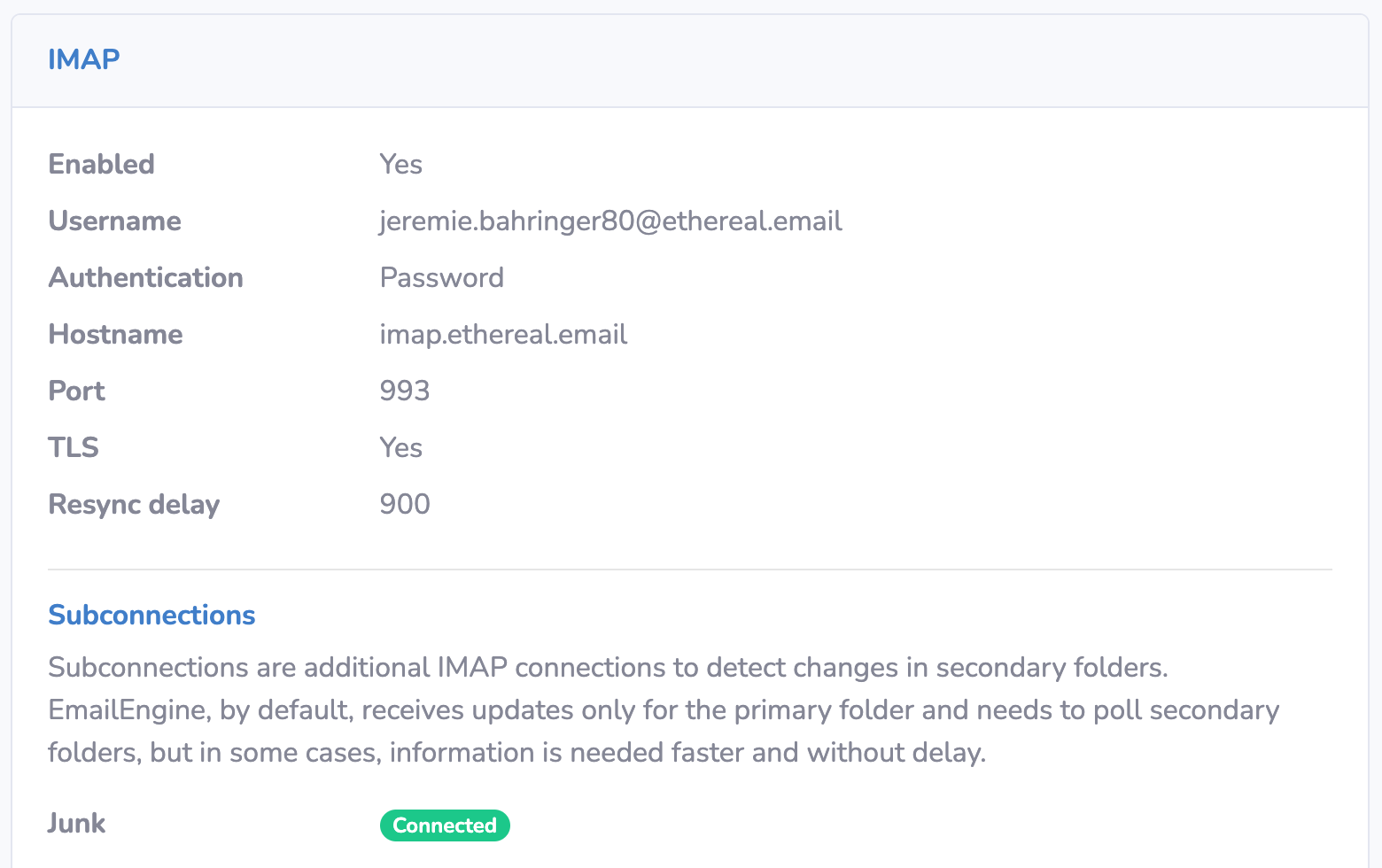
The API returns the configured list, not the live state:
curl "https://emailengine.example.com/v1/account/seed-gmail-1" \
  -H "Authorization: Bearer YOUR_ACCESS_TOKEN" \
  | jq '.subconnections'
["\\Junk", "\\Trash"]
Gmail Category Detection
Gmail sorts inbox mail into category tabs:
- Primary - personal mail and direct correspondence
- Social - social network notifications
- Promotions - marketing mail and offers
- Updates - confirmations, receipts, statements
- Forums - mailing lists and discussion groups

Gmail API vs IMAP
How the category reaches you depends on how the Gmail account is connected:
Gmail API accounts: the category comes with the message's labels, so it is always present. Message listings, message details and the messageNew, messageUpdated and messageDeleted webhooks carry a category field with one of primary, social, promotions, updates or forums. Nothing needs to be configured.
IMAP accounts: the category is not part of the IMAP data. When enabled, EmailEngine runs a Gmail search (category:primary, category:social, and so on, in that order) for each new INBOX message on a Gmail account, which is one extra IMAP command per category tried. It is off by default for that reason, and the result appears only in the messageNew webhook, not in message listings.
If the seed accounts exist for placement testing only, connecting Gmail through the API avoids the extra IMAP traffic.
Enable Category Detection (IMAP only)
Enable in UI
- Go to Configuration > Email Processing
- Scroll to the Gmail Features card
- Tick Detect Gmail Categories (IMAP)
- Save
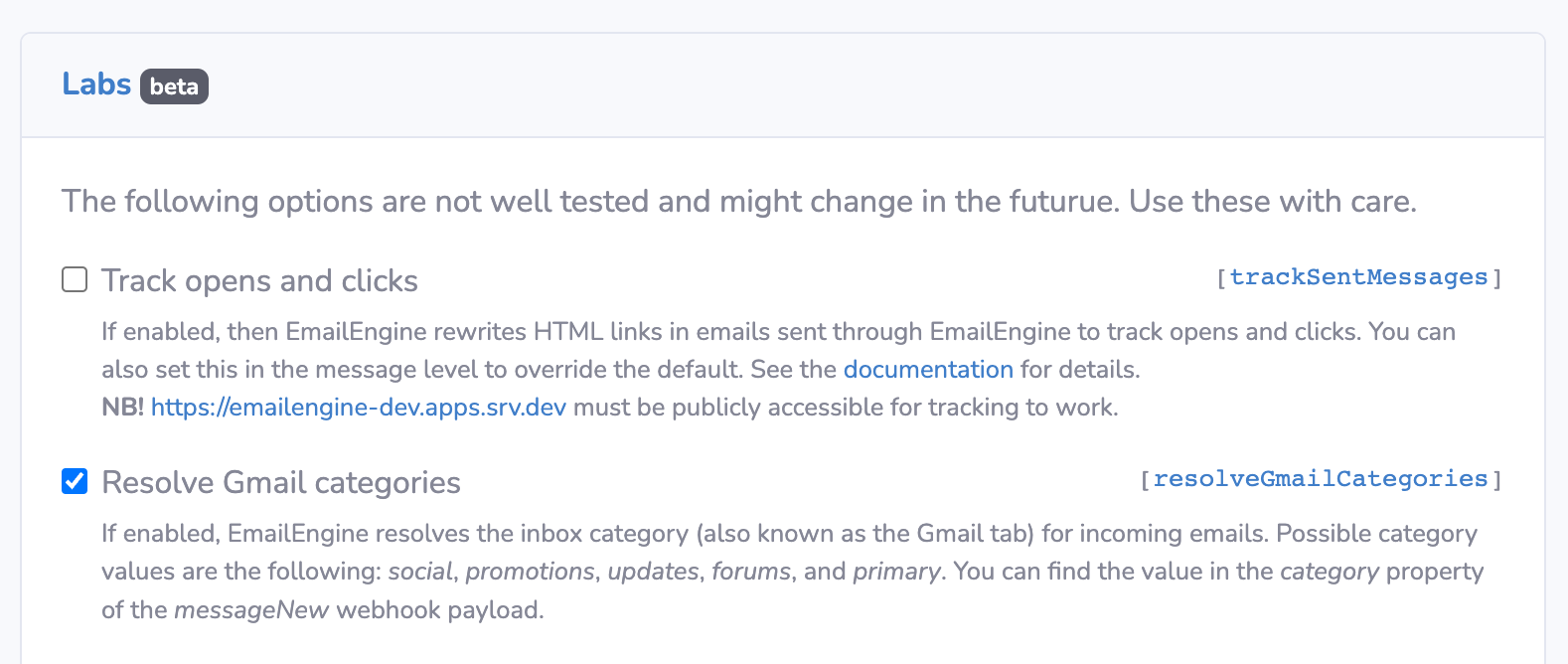
Enable via Settings API
curl -X POST "https://emailengine.example.com/v1/settings" \
  -H "Authorization: Bearer YOUR_ACCESS_TOKEN" \
  -H "Content-Type: application/json" \
  -d '{"resolveGmailCategories": true}'
Or preconfigure it at startup with the EENGINE_SETTINGS environment variable:
EENGINE_SETTINGS='{"resolveGmailCategories":true}' emailengine
Category in Webhooks
With detection enabled, the messageNew webhook for a Gmail INBOX message includes category inside data:
{
  "event": "messageNew",
  "account": "seed-gmail-1",
  "path": "INBOX",
  "data": {
    "id": "AAAABgAAAdk",
    "path": "INBOX",
    "subject": "Special Offer - 50% Off!",
    "category": "promotions",
    "from": {
      "name": "Marketing",
      "address": "marketing@example.com"
    }
  }
}
Values on an IMAP account are primary, social, promotions, updates, forums, reservations or purchases, the categories EmailEngine tries in turn. Gmail API accounts report the five tab categories only.
Implementing Inbox Placement Tests
How the Test Works
An inbox placement test is a loop over a seed list:
- Send the message to each seed address, with a unique marker in the subject so you can find it again.
- Wait for delivery. Give it 30 seconds or more, since providers do not deliver instantly.
- Match the
messageNewwebhook for each seed mailbox against the marker, and read itspathandcategory. - Score the result: which folder it landed in, per provider.
The marker matters. Matching on subject alone collides with earlier runs of the same campaign, and a stale hit reports yesterday's placement as today's.
The example below implements all four steps. It sends through an EmailEngine account called sender and expects EmailEngine to deliver webhooks for the seed accounts to your application, which calls process_webhook() for each one.
Python Example
import re
import time
from datetime import datetime

import requests


class DeliveryTester:
    def __init__(self, api_url, token):
        self.api_url = api_url
        self.token = token
        self.test_emails = {}

    def send_test_email(self, test_account, subject, content):
        test_id = f"test-{int(time.time() * 1000)}"

        response = requests.post(
            f"{self.api_url}/v1/account/sender/submit",
            headers={
                "Authorization": f"Bearer {self.token}",
                "Content-Type": "application/json",
            },
            json={
                "to": [{"address": test_account}],
                "subject": f"{subject} [Test:{test_id}]",
                "text": content,
            },
        )
        response.raise_for_status()
        data = response.json()

        self.test_emails[test_id] = {
            "message_id": data["messageId"],
            "test_account": test_account,
            "subject": subject,
            "sent_at": datetime.now(),
            "result": None,
        }

        return test_id

    def process_webhook(self, webhook):
        """Call this for every webhook EmailEngine delivers to your application"""
        if webhook["event"] != "messageNew":
            return

        data = webhook["data"]
        match = re.search(r"\[Test:([^\]]+)\]", data.get("subject", ""))
        if not match:
            return

        test = self.test_emails.get(match.group(1))
        if not test:
            return

        path = webhook["path"]
        if path == "INBOX":
            status = "inbox"
        elif "Junk" in path or "Spam" in path:
            status = "spam"
        else:
            status = "other"

        test["result"] = {
            "folder": path,
            "category": data.get("category"),
            "delivered_at": datetime.now(),
            "delivery_time_sec": (datetime.now() - test["sent_at"]).total_seconds(),
            "status": status,
        }

    def run_seed_list_test(self, seed_list, subject, content):
        return [
            {"email": email, "test_id": self.send_test_email(email, subject, content)}
            for email in seed_list
        ]

    def check_results(self, accounts, timeout=30):
        """Wait, then summarise what arrived"""
        time.sleep(timeout)

        completed = []
        pending = []

        for account in accounts:
            test = self.test_emails[account["test_id"]]
            if test["result"]:
                completed.append({"email": account["email"], **test["result"]})
            else:
                pending.append(account["email"])

        inbox_count = sum(1 for r in completed if r["status"] == "inbox")
        spam_count = sum(1 for r in completed if r["status"] == "spam")

        return {
            "total": len(accounts),
            "completed": len(completed),
            "pending": len(pending),
            "inbox_rate": f"{inbox_count / len(completed) * 100:.1f}%" if completed else "N/A",
            "spam_rate": f"{spam_count / len(completed) * 100:.1f}%" if completed else "N/A",
            "results": completed,
        }


tester = DeliveryTester("https://emailengine.example.com", "YOUR_ACCESS_TOKEN")

seed_list = ["test1@gmail.com", "test2@outlook.com", "test3@yahoo.com"]

accounts = tester.run_seed_list_test(
    seed_list, "Marketing Email - Special Offer", "Check out our exclusive deals!"
)

results = tester.check_results(accounts, timeout=30)
print(f"Inbox rate: {results['inbox_rate']}")
print(f"Spam rate: {results['spam_rate']}")
Analyzing Results
Track Deliverability Metrics
The function below takes the results array produced above and breaks it down by provider and, for Gmail, by category:
function analyzePlacementResults(results) {
  const stats = {
    total: results.length,
    inbox: 0,
    spam: 0,
    other: 0,
    byProvider: {},
    byCategory: {},
    avgDeliveryTimeSec: 0
  };

  let totalDeliveryTime = 0;

  for (const result of results) {
    stats[result.status]++;

    const domain = result.email.split("@")[1];
    stats.byProvider[domain] = stats.byProvider[domain] || { inbox: 0, spam: 0, other: 0 };
    stats.byProvider[domain][result.status]++;

    if (result.category) {
      stats.byCategory[result.category] = (stats.byCategory[result.category] || 0) + 1;
    }

    totalDeliveryTime += result.delivery_time_sec;
  }

  stats.avgDeliveryTimeSec = results.length ? (totalDeliveryTime / results.length).toFixed(1) : 0;
  stats.inboxRate = results.length ? ((stats.inbox / results.length) * 100).toFixed(1) + "%" : "N/A";
  stats.spamRate = results.length ? ((stats.spam / results.length) * 100).toFixed(1) + "%" : "N/A";

  return stats;
}
Generate Report
function generateDeliveryReport(stats) {
  console.log("=== Delivery Test Report ===");
  console.log(`Total: ${stats.total}`);
  console.log(`Inbox: ${stats.inbox} (${stats.inboxRate})`);
  console.log(`Spam: ${stats.spam} (${stats.spamRate})`);
  console.log(`Other: ${stats.other}`);
  console.log(`Average delivery time: ${stats.avgDeliveryTimeSec}s`);

  console.log("--- By provider ---");
  for (const [provider, counts] of Object.entries(stats.byProvider)) {
    const total = counts.inbox + counts.spam + counts.other;
    console.log(`${provider}: ${counts.inbox}/${total} inbox`);
  }

  console.log("--- Gmail categories ---");
  for (const [category, count] of Object.entries(stats.byCategory)) {
    console.log(`${category}: ${count}`);
  }
}
See Also
- Performance tuning - Which sub-connection paths EmailEngine accepts and what a disabled entry means
- Email authentication testing - The delivery test endpoints for SPF, DKIM and DMARC
- messageNew webhook - The payload the test reads
pathandcategoryfrom - Gmail via IMAP - Connecting a Gmail seed account over IMAP
- Managing accounts - Changing
subconnectionson an existing account